How Australian Restaurants Can Grow with the Right Tech Stack in 2026
Let’s call it what it is, the Aussie hospitality scene is getting properly competitive.
Between rising costs, staffing headaches, and customers expecting everything fast and flawless, running a restaurant today isn’t just about good food anymore. It’s about how efficiently you run the whole operation.
The venues that are growing in 2026? They’re not necessarily working harder. They’re just running smarter systems behind the scenes.
If you’re sitting in that “doing alright but could do better” zone, your tech stack might be the missing piece.
Why Your Current Setup Might Be Holding You Back
A lot of restaurants already use tech, but here’s the issue: it’s often disconnected.
One system for orders, another for payments, something else for delivery. Nothing talks to each other. That’s where time gets wasted, and mistakes creep in.
A proper restaurant tech stack in Australia should feel like one smooth system, not a patchwork of tools. It should help you:
- Move faster during peak hours
- Cut down manual work
- Keep customers happy
- Give you actual insights, not guesswork
If it feels clunky, it probably is.
The Core Tools Aussie Restaurants Are Using to Grow
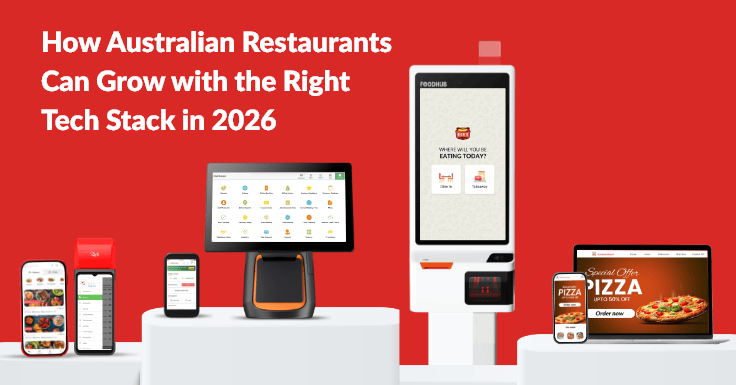
Instead of throwing random tools together, successful restaurants are building a connected setup that actually supports growth.
Here’s how each piece plays its role
1. POS System: Your Operational Backbone
Your restaurant POS system is where everything starts.
It doesn’t just process orders; it gives you visibility across sales, stock, and performance. You’re no longer guessing what’s working. You know.
For Aussie restaurants dealing with tight margins, that clarity is massive.
2. Online Ordering: Stop Losing Money to Commissions
Third-party apps are great for reach, but they take a serious cut. With your own online ordering system, you:
- Keep more profit per order
- Build a direct relationship with customers
- Run your own offers and promotions
It’s less about convenience now, more about control.
3. Kiosks: More Orders, Less Pressure on Staff
Self-service kiosks are becoming a standard across busy Australian venues. Customers take their time ordering, customise freely, and often spend more.
Meanwhile, your staff isn’t stuck handling queues all day. Win-win.
4. Mobile Ordering: Speed Up Service Without Adding Staff
Letting your team take orders on handheld devices completely changes the flow. No back-and-forth to the counter.
No unnecessary delays. This works brilliantly in cafes, casual dining spots, and larger venues.
5. Kitchen Display System: Keep the Chaos Out of the Kitchen
Paper tickets can slow everything down, especially during rush hours. A KDS keeps orders organised, visible, and easy to manage. Less confusion. Reduced mistakes. Faster prep.
Tech Stack Breakdown (What Each Tool Really Brings to the Table)
Here’s a clearer look at how these tools actually impact your day-to-day operations:
Tech tool | What it helps you do | Real impact on your business | When it becomes essential |
POS system | Manage orders, sales, and reporting | Gives full visibility and control | When you want to scale or optimise operations |
Online ordering | Take direct customer orders | Cuts commission costs and boosts margins | When delivery is a big part of revenue |
Kiosk | Let customers self-order | Increases average order value | When queues start affecting service |
Mobile POS | Take orders anywhere | Speeds up service and reduces delays | When staff efficiency needs improvement |
KDS | Manage kitchen orders digitally | Reduces errors and improves speed | When kitchen gets overwhelmed |
Update menus instantly | Helps upsell and stay flexible | When pricing/promos change often | |
Handle transactions smoothly | Improves checkout experience | When slow payments hurt flow | |
Let customers order via phone | Reduces waiting time | When staff is stretched | |
Connect all systems together | Removes manual work and errors | When using multiple tools | |
Data insights | Track performance trends | Helps make smarter decisions | When growth decisions matter |
Where Most Restaurants Get It Wrong
Here’s the catch. A lot of businesses invest in these tools individually but never connect them. That’s where things fall apart. Without proper integrations, you’re still:
- Entering data manually
- Dealing with mismatched reports
- Fixing avoidable errors
The real growth comes when everything works together as one system.
What Growth Actually Looks Like in 2026
Restaurants that are scaling right now are focusing on:
- Faster service without increasing staff
- Higher order values through smarter ordering systems
- Better margins by reducing third-party dependency
- Smoother operations with fewer mistakes
It’s not about adding more complexity. It’s about simplifying how everything runs.
Final Thought: It’s Not About Tech, It’s About How You Use It
At the end of the day, tech isn’t the goal. Growth is. The right restaurant technology stack just makes that growth easier, faster, and more predictable.
If your current setup feels like it’s slowing you down, it probably is. And in a market like Australia, staying average isn’t really an option anymore.
Ready to Upgrade How Your Restaurant Runs?
With Foodhub for Business, you’re not just adding tools, you’re building a connected system that actually works for you.
From POS and mobile ordering to kiosks, online ordering, payments, and integrations, everything is designed to run smoothly together, so you can focus on what matters most.
- Take more direct orders and cut down on commissions
- Speed up service without increasing staff costs
- Keep your operations running seamlessly, even during peak hours
- Get real insights to make smarter business decisions
No patchwork. No confusion. Just one system that helps you grow.
Have a look at how Foodhub for Business can support your setup, and see what your restaurant could be doing better.
.png)