If the phrase “artificial intelligence” makes you picture robots flipping burgers or software telling you how to run your kitchen, take a breath. That is not what is happening here.
By 2026, AI in restaurants is becoming less about futuristic headlines and more about practical tools quietly helping owners survive an increasingly demanding industry. Most of it happens behind the scenes, and chances are you have already encountered it without realising.
So let us talk about what AI actually means for restaurants, without the drama.
What AI for Restaurants Really Looks Like
At its core, AI for restaurants is about systems that learn from data and use those patterns to support better decisions. It is not about replacing people. It is about removing friction.
In real terms, AI often appears as:
- Ordering systems that adapt to customer behaviour
- Tools like an EPOS system that help forecast busy periods
- Software that supports smarter stock planning
- Automated responses that reduce admin work
If your restaurant already uses digital ordering, reporting tools, or customer insights, you are already on the path.
Why AI in Restaurants is Becoming Hard to Ignore
The reason AI is gaining traction is not hype. It is pressure.
Rising costs, staffing challenges, and changing customer expectations have pushed restaurant owners to look for ways to do more with less.
AI helps by handling repetitive analysis and spotting patterns that humans simply do not have time to process during service. It does not take breaks. It does not forget. And it does not mind doing the boring stuff.
Where AI in Restaurants is Actually Being Used
AI is not a single solution. It shows up in several practical areas of restaurant operations.
1. Improving the Ordering Experience
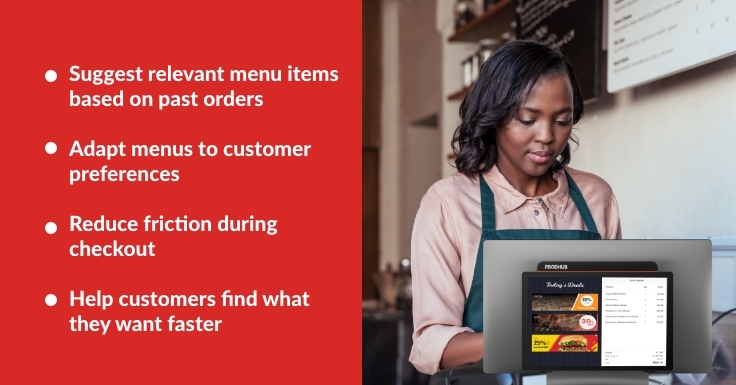
One of the most noticeable uses of AI in restaurants is in digital ordering.
AI can:
- Suggest relevant menu items based on past orders
- Adapt menus to customer preferences
- Reduce friction during checkout
- Help customers find what they want faster
This leads to smoother ordering journeys and fewer abandoned orders, which benefits both customers and businesses.
2. Supporting Smarter Operations
Behind the scenes, AI for restaurants quietly shines. By analysing historical data, AI tools can help:
- Anticipate busy shifts
- Improve prep planning
- Support staff scheduling
- Reduce last-minute guesswork
Instead of relying purely on instinct, owners can make informed decisions based on how the restaurant actually operates week after week.
3. Making Marketing Less of a Guessing Game
Marketing often feels like throwing offers into the void and hoping something sticks. AI in restaurants helps change that by analysing customer behaviour. It can identify patterns such as:
- Regular ordering habits
- Popular menu items
- Best times to engage customers
- Signs of customer drop-off
This enables restaurants to communicate more effectively, focusing on relevance rather than volume.
4. Reducing Waste and Improving Stock Control

Over-ordering and food waste quietly eat into profits. AI tools can analyse demand trends to support better stock planning. This helps restaurants:
- Order more accurately
- Reduce unnecessary waste
- Avoid running out of popular items
It is not glamorous, but it makes a real difference to margins.
What AI in Restaurants Will Not Do
Despite what the headlines suggest, AI is not here to take over hospitality.
It will not:
- Replace chefs or front-of-house teams
- Make perfect decisions without human input
- Fix operational problems overnight
- Remove the need for experience and judgement
AI works best when it supports people rather than attempts to replace them.
Getting Ready for AI in 2026 Without Overcomplicating Things
You do not need a complete technology overhaul to benefit from AI for restaurants.
A sensible approach includes:
- Keeping data organised and accurate
- Choosing systems that integrate smoothly
- Training staff gradually
- Testing tools before fully committing
Small steps often lead to better results than rushed decisions.
The UK Perspective on AI in Restaurants
The UK restaurant industry has its own challenges. Here, AI adoption tends to focus on:
- Efficiency over novelty
- Managing labour pressures
- Protecting margins
- Meeting customer expectations for speed and value
UK customers care about convenience, but not at the expense of quality. AI helps strike that balance when used thoughtfully.
What the Future Looks Like Beyond 2026
As we move towards 2026, AI in restaurants is likely to become less visible and more embedded.
Instead of standalone tools, AI will be:
- Built into everyday systems
- Easier to use
- More focused on practical outcomes
- Part of the background rather than the headline
The most successful restaurants will be those that understand where AI helps and where it does not.
Final Thoughts: Understanding Before Adopting
AI for restaurants is not about chasing trends. It is about understanding which tools genuinely support the way your business operates.
You do not need to adopt everything at once, and you certainly do not need to turn your restaurant into a tech experiment. What matters is staying informed, asking the right questions, and choosing solutions that fit naturally into your day-to-day workflow.
Good food, good service, and human judgment will always sit at the heart of hospitality. Technology should simply help you deliver those things more consistently and with less pressure behind the scenes.
This is where platforms like Foodhub for Business come in, offering a restaurant management system designed to support ordering, operations, and customer engagement without adding unnecessary complexity.
AI is not here to take over hospitality. It is here to make running a restaurant a little easier.