Let’s not overcomplicate this.
If your restaurant is running multiple delivery platforms without integration, you are not operating efficiently. You are managing workarounds.
Orders coming in from different apps, staff manually entering them into the POS, and delays building up during peak hours. It might feel manageable on a quiet day, but it does not scale.
This is where third-party food delivery integration becomes essential.
What is Third-Party Food Delivery Integration?
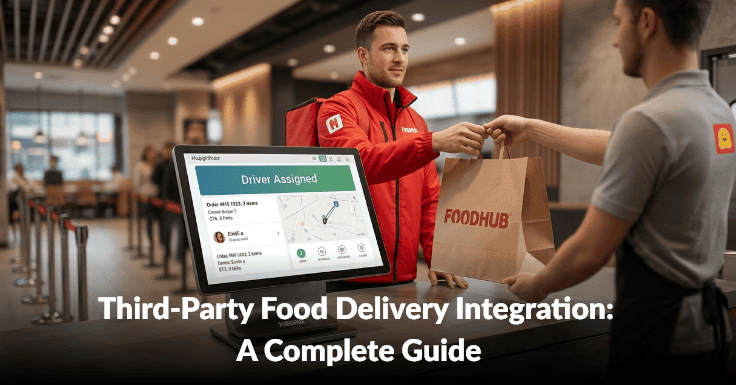
At its core, food delivery integration connects your delivery platforms directly with your POS system. Instead of handling each order separately, everything flows into one system automatically.
What changes:
- Orders move directly from delivery apps to your POS
- Kitchen tickets are generated instantly
- Menu updates sync across platforms
- Staff no longer re-enter data
It is less about adding new technology and more about making your existing systems work together properly.
Manual Orders vs Integrated Orders
Here is a clear comparison of how operations differ:
Area | Without Integration | With Integration |
Order handling | Manual entry from multiple tablets | Automatic flow into POS |
Speed | Slower, depends on staff availability | Instant order processing |
Accuracy | Higher chance of human error | Significantly reduced errors |
Staff workload | Repetitive and time-consuming | Focus on preparation and service |
Order tracking | Split across platforms | Centralised in one system |
The difference is operational clarity. One relies on people juggling systems. The other relies on systems doing the heavy lifting.
How Food Delivery POS Integration Works
With food delivery POS integration, the process becomes straightforward:
- A customer places an order on a delivery app
- The order is transmitted directly to your POS
- The POS sends it to the kitchen instantly
- All data is recorded in one place for reporting and tracking
There is no duplication, no delays, and no dependency on manual input.
Types of Delivery App Integration
Not every setup is identical. Understanding the types helps in choosing the right approach.
Integration Types Compared
Type | How It Works | Best For | Considerations |
Direct Integration | POS connects directly to delivery platforms | Single or limited platforms | Limited flexibility across apps |
Middleware | A central system connects POS with multiple platforms | Multi-platform operations | Requires a reliable intermediary |
Hybrid | A combination of direct and middleware | Growing or multi-location businesses | Slightly more complex setup |
Each model serves a purpose. The right choice depends on how many platforms you use and how you plan to scale.
Why Delivery App Integration Matters
The benefits are not just operational. They directly impact revenue and customer experience.
Key advantages of delivery app integration:
- Faster service - Orders reach the kitchen without delay
- Improved accuracy- No retyping means fewer mistakes
- Centralised control- All orders are managed from one dashboard
- Better staff productivity - Teams focus on fulfilment rather than admin
The Cost of Not Integrating
Many restaurants underestimate this.
Without proper food delivery integration, the hidden costs build up:
Issue | Impact on Business |
Missed orders | Direct revenue loss |
Incorrect orders | Refunds and negative reviews |
Slow processing | Reduced order volume during peak hours |
Staff overload | Lower efficiency and higher turnover risk |
These are not occasional problems. They become daily friction points.
What to Look for in a Food Delivery Integration Solution
Not all solutions deliver the same value. Here are the essentials:
- Real-time syncing - Orders should appear instantly in your POS
- Multi-platform compatibility - Ability to connect with major delivery apps
- Menu synchronisation - Update once and reflect everywhere
- Reliable POS connection - A stable food delivery POS integration is non-negotiable
- Scalability - The system should support future growth
Where This Fits in Your Growth Strategy
Integration is not just about fixing inefficiencies. It is about preparing your business for scale.
When your systems are connected:
- You handle higher-order volumes without increasing staff
- You reduce operational errors as you grow
- You create a consistent customer experience across channels
It shifts your operations from reactive to structured.
Final Thoughts
Restaurants today are not just competing on food quality. They are competing on speed, accuracy, and experience. Without third-party food delivery integration, you are relying on manual processes in a system that demands automation.
With the right delivery app integration, your operations become simpler, faster, and far more reliable. In fact, integrated systems reduce manual errors, streamline operations, and improve overall efficiency across UK hospitality businesses.
And that is what allows you to grow without losing control.
If you are serious about scaling your restaurant without the operational chaos, it is time to look at a solution that brings everything together.
Foodhub for Business helps you:
- Integrate all your delivery platforms into one system
- Sync your POS with online orders in real time
- Reduce reliance on third-party commissions by building your own ordering channels
No juggling tablets. No missed orders. Just one connected system that works.
Book a demo with Foodhub for Business and see how seamless your operations can actually be.